Welcome to the Tyler Park Neighborhood Association!
The Tyler Park Fund is the charitable arm of the Tyler Park Neighborhood Association and a 501(c)(3) public charity in its own right. The fund supports improvements to the park and in the past has been used to help fund the revitalization efforts of the new tennis courts, splash pad, and playground. Any funds donated here will be put toward durable park improvements that will be enjoyed for generations. The park belongs to the whole city, and the work of keeping it that way is open to anyone who wants a hand in it.
The Tyler Park Neighborhood Association helps make our neighborhood a great place to live. We bring our neighbors together with free events like the annual Easter Egg hunt, the Sundays in September Jazz Festival, and Festival of Hope. We also raise money for operations, park improvements, and neighborhood beautification.
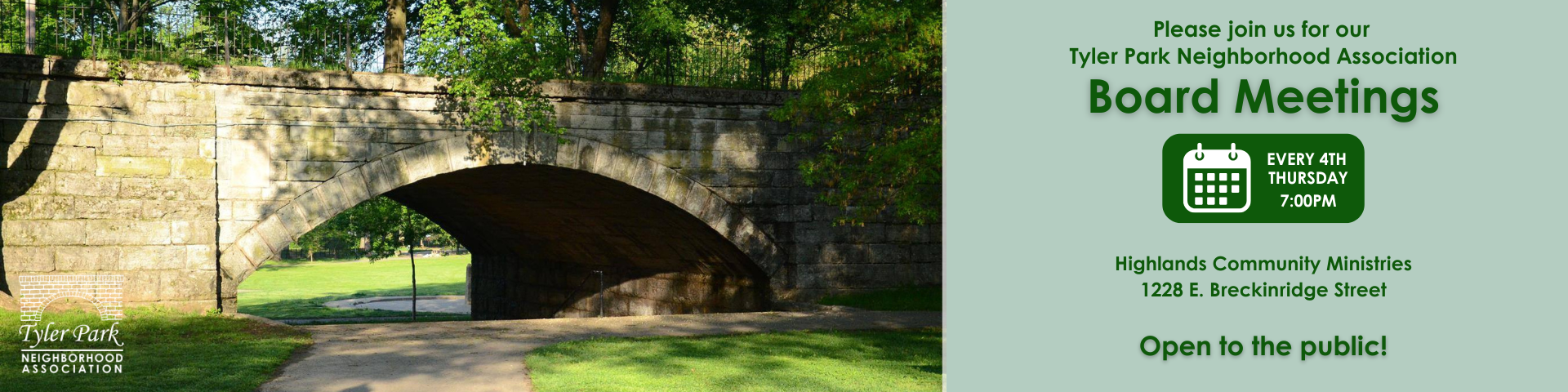
If you’re interested in participating, consider attending the TPNA Board meetings on the 4th Thursday of each month from January thru October (November TBD) at 7:00 PM at our interim location, Highlands Community Ministries, 1228 E. Breckinridge Street, 40204.
Farewell to Mid-City Mall!
A Storied History
By Ray Brundige
Secretary, TPNA
Writing a story on the history of the Mid-City Mall has the problem of when to start. Eons ago when the limestone formed? Thousands of years ago when the first Americans arrived? In 1774 when a survey said the Taylor family owned the land? Problem solved. Start with July 3, 1901.
In case you missed it, that’s when the Courier-Journal printed the news that Emma Moore had sold 10.53 acres on Baxter Avenue northwest of Rosewood for $50,000, $20,000 of it in cash, to the German Protestant Orphan’s Asylum. That’s the land now assessed at $11,000,000.
So at least part of the story is growth. The original Taylor acreage had broken up, changing from small farms and estates like hers into commuter suburbs. Ten of our neighborhood subdivisions were plotted before her deed and another fifteen before the Wall Street crash. When she signed, Rosewood, Mossrose, Bellwood and Beechwood Avenues had been in place for at least twelve years. Two years after she signed, the Orphanage had its main building. It ultimately had three main buildings, a deeply shaded front lawn, and gardens to feed resident staff and children. By 1904 our signature stone bridge and Goddard’s street were in place. By 1907 our namesake park had been dedicated.
That takes us to November 16, 1958, another starting point. That’s when the Courier ran a story about a $500,000 offer for the land by an investment group planning a five-story retail center that would cost $7,500,000. Details changed in the next few years but a reorganized group eventually closed the deal. Two years after the story ran, the children living at the orphanage moved to their new home at 2125 Goldsmith Lane, Brooklawn. Five days later, on December 1, 1960, wrecking crews started demolition. They cut down 200 maples, elms, and oaks; tore down every building; and scraped the sod and topsoil off the grounds. Construction was delayed but work on a revised $3,000,000 plan began in the spring of 1961 where 1,200 parking spaces would surround a single large building, no trees, with retail activity mostly on the first floor. A bowling alley and cocktail lounge would be on the lower-level facing expanded parking on Beechwood Avenue. Seven of the street’s residences had been bought and a wrecking permit granted.
The bowling alley opened first, three days before a ribbon-cutting ceremony on October 10, 1962 and the first day of business for most of the other tenants. The Courier identified twenty, noting eleven were “scheduled to open soon”. Advertisements had deals like turkeys for 29¢ / lb. at Winn-Dixie and whole frying chickens for 25¢ / lb. at the A&P. (Winn-Dixie was in the space ValuMarket took over in 2005 and A&P was at the opposite end.) With the openings, the Mid-City Mall took its place at the heart of our community.
The story since then has been, in a word, neighborly. There have been departures, new arrivals, errors in judgment, spats, and celebrations. We’ve shared life.
The first spat came to light the evening after the ribbon-cutting. Mayor Cowger was hosting a community meeting, and Beechwood residents expressed their displeasure with the planned demolition of the houses in the middle of their block. He promised to look into the zoning, and did. The wrecking permits had been issued, so the houses were not saved, but rulings on zoning did stop the expansion of the parking lots into the residential area.
Further controversaries came in those early years, mostly involved with The Office Lounge, a nightclub at the bowling alley. There were complaints about juvenile drinking, an after-hours tussle with the police, and liquor law violations. By the late 60’s the club had want ads seeking “Go Go dancers for luncheons” and was using the line “Honey, I have to stay late at the office”. Those problems and trash in the parking lots led to a nine-day neighborhood boycott in 1975 by five neighborhood associations, TPNA included. The Mall went into receivership and was sold to a partnership organized by Frank Metts in 1977.
Another starting place. The Office Lounge closed; the bowling alley was replaced by Champs Rollerdrome. Agreements were reached to allow use of Beechwood Avenue parking if there were a uniformed guard at the entrance. An investigation found the permit terms were being violated, and an inspection found maintenance issues as well. TPNA President Dinah Smith thanked the Metts group’s response to the maintenance issues but urged BOZA to revoke the parking permit if the guard was not provided. The Board agreed with her.
Things quieted down, mostly. Entertainment venues still clashed with residents’ needs for sleep from time to time. The Back Door had some of the same disputes as the Office, but at a lower level. So, the next spat was residents trying to prevent problems, rather than complaining about existing conditions. The issue was the potential impact of the planned 1996 opening of eight movie theaters on the Baxter Avenue end of the mall. The mall’s neighbors had watched the discussions for a planned renovation of the Schuster Building at 1500 Bardstown that would have included the theaters, and had their defense ready when the cinemas plan shifted to the mall. The top issues were operating hours, use of the alleys, traffic volumes, and the effect of waves of movie-goers exiting on Goddard. It took two years to reach a deal, and a third to build the Baxter Avenue Theaters for their public opening on September 20, 1996.
The theaters, and the City Café renovations a few years later, showed the value of dialogue in a community. The next challenge came in 2004, when the Winn-Dixie corporation was undergoing bankruptcy. A&P having left the region years before, a closing would mean no grocery store in walking distance and would also have a real effect on the mall’s revenues. The community was surveyed, and when Buehler’s Fresh Market reopened the Winn Dixie branch on October 29, the mall had a $500,000 renovation underway. The survey results had made it clear the neighbors needed a grocery store, and had felt the mall was looking a bit tired.
And neighborly accommodation has remained in place since then. Businesses have come and gone, appreciated by residents or sometimes missing, and the mall management has invested in keeping the property fresh, most recently in 2015. ValuMarket became a community fixture with its gift cards program, its wine festival sponsorship, and continuous civic support. Unmentioned so far, the Highlands Shelby Park branch of the Louisville Free Public Library became a home away from home for many of us since its opening at the mall in 1992, and for our teens with the opening of the Outpost in 2001. The small businesses and services have kept us going. We have been blessed with so many of them. The Jewel Box, The Comedy Caravan, Nearly New Shop, Norton Medical Associates, Doctor Gabor’s Dental, Mid City Barbell which operated for 50 years in the lower level are just a few of these wonderful gems that we will not forget. Please let us know what you will miss most about the old MCM so TPNA can compile a list for historical purposes.
Now we are heading for another starting point, and another story. The challenges of shutting down, tearing down, and then rebuilding will be tough. It is our good fortune that we have learned to listen to each other. The joy of life should be shared.
| The First Units Listed in the Courier-Journal’s Ribbon-Cutting Article The Mid-City Lanes; Kresge’s; a Zayre Department Store; A&P and Winn-Dixie grocery stores; a Taylor Drug Store; the Card Mart; the Book Nook; a Citizens Fidelity Bank & Trust branch; the Kentucky Security Police; a cocktail lounge named “The Office”; Ehrmann’s Bakery; Marianne; the Maison Beaux Beauty Shop; the Maud Miller Candy Shop; the Mid-City Barber Shop; the Bavarian Sidewalk Café; and, unnamed in the article, a florist, a finance company; a food and produce store; a men’s shop; and a shoe store. |